What are salteñas?
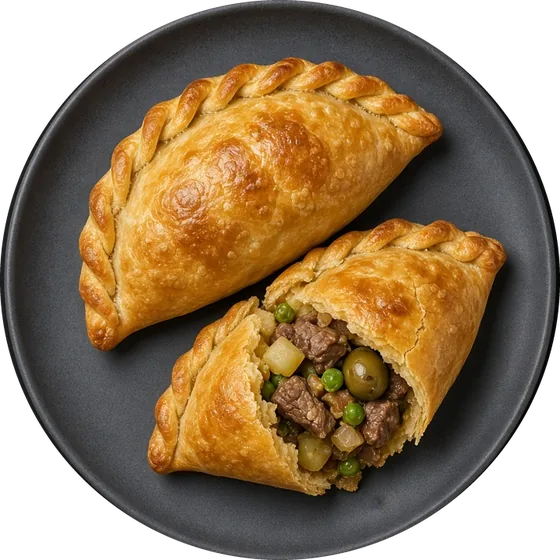
Salteñas are Bolivia's broth-filled empanadas: a baked pastry filled with a stew (jigote) of meat with potato and chili (ají) that releases juice when cooked. They differ from other empanadas in three things: the broth, the ají and the potato.[1][2]
What is in salteñas (Bolivian pastries)?
- Baked empanada dough
- Jigote: a stew of beef or chicken, sometimes fish
- Potato and ají
- Trotter gelatin, which melts in the oven and forms the broth
According to [1]
Where does salteñas (Bolivian pastries) come from?
Historian Beatriz Rossells, quoted by Correo del Sur, places the origin in colonial Potosí: the empanada the Spanish brought was changed with ají, potato and broth. The oldest evidence is the handwritten cookbook of Josepha de Escurrechea, from 1776, which includes a broth empanada. In Sucre they were still called "empanadas de caldo" until the 1970s.[1][2]
The name has a popular story: folklorist Antonio Paredes Candia told that the family of writer Juana Manuela Gorriti, exiled from Salta (Argentina) around 1831, sold empanadas to get by, and people called them "salteñas". Rossells and Ramón Rocha Monroy doubt it: Gorriti's cookbook, Cocina ecléctica, has no empanada with ají or potato, and she admitted in the prologue that she could not cook.[1][3]
Another version, from historian Walter Zavala, says that around 1830 a woman from Salta named Corina Pueyrredón sold broth empanadas in Potosí and people asked for them "from the salteña". And the story of Leonor de Guzmán inventing them in Potosí against the cold is fiction: its author, Rocha Monroy, admitted he made it up for his novel Potosí 1600.[1][4]
Types of salteñas (Bolivian pastries)
The filling can be meat or fish; colonial cookbooks also mention sweet additions and baking or frying.[2]
The empanadas of Puno and Juliaca, in Peru, which claim kinship, have no juice.[1]
Other names
The demonym "salteña" became a noun. Potosí columnists insist that, despite the name, the salteña "is not from Salta".[1][3]
When is salteñas (Bolivian pastries) eaten?
It is quick, cheap food for people in a hurry, bought at salteñerías. In Cochabamba it is a tradition to eat them on Sundays and, above all, on Father's Day, March 19: salteñerías sell up to ten times more that day.[5][6]
Did you know?
The salteña was declared heritage of the Plurinational State of Bolivia in 2014, and Potosí celebrates Salteña Day on November 10.[5][4]
Potosí and La Paz dispute the origin. In 2017 the mayor of Potosí claimed the Potosí origin in La Paz, based on a 2012 municipal law that declared the salteña and 21 other foods heritage.[2]
Frequently asked questions
What are salteñas?
Salteñas are Bolivia's broth-filled empanadas: a baked pastry filled with a stew (jigote) of meat with potato and chili (ají) that releases juice when cooked. They differ from other empanadas in three things: the broth, the ají and the potato.
What are the ingredients of salteñas (Bolivian pastries)?
Baked empanada dough; Jigote: a stew of beef or chicken, sometimes fish; Potato and ají; Trotter gelatin, which melts in the oven and forms the broth.
Where is salteñas (Bolivian pastries) from?
Historian Beatriz Rossells, quoted by Correo del Sur, places the origin in colonial Potosí: the empanada the Spanish brought was changed with ají, potato and broth. The oldest evidence is the handwritten cookbook of Josepha de Escurrechea, from 1776, which includes a broth empanada. In Sucre they were still called "empanadas de caldo" until the 1970s.
When is salteñas (Bolivian pastries) eaten?
It is quick, cheap food for people in a hurry, bought at salteñerías. In Cochabamba it is a tradition to eat them on Sundays and, above all, on Father's Day, March 19: salteñerías sell up to ten times more that day.
Sources
- Correo del Sur (Juan José Toro Montoya): La «salteña» no es de Salta
- Correo del Sur (Juan José Toro Montoya): La jugosa y picante historia de la «salteña»
- Los Tiempos (Juan José Toro Montoya): Salteñas
- Correo del Sur: Aclaran cuál es el origen potosino de la salteña
- Los Tiempos (Gabriel López Pedro): Desmitificando a la salteña: ¿por qué es tan popular en el Día del Padre?
- Nueva Sociedad: La Paz, territorio libre de McDonald's
Researched and checked on November 25, 2026. Legends and disputed claims are marked as such in the text. How we work
Other dishes
What is a chivito? · What is an arepa? · What is feijoada? · What is lomo saltado? · What is a milanesa? · What is ceviche? · What is pabellón criollo? · What is asado de tira? · What is pastel de choclo? · What is bandeja paisa? · all